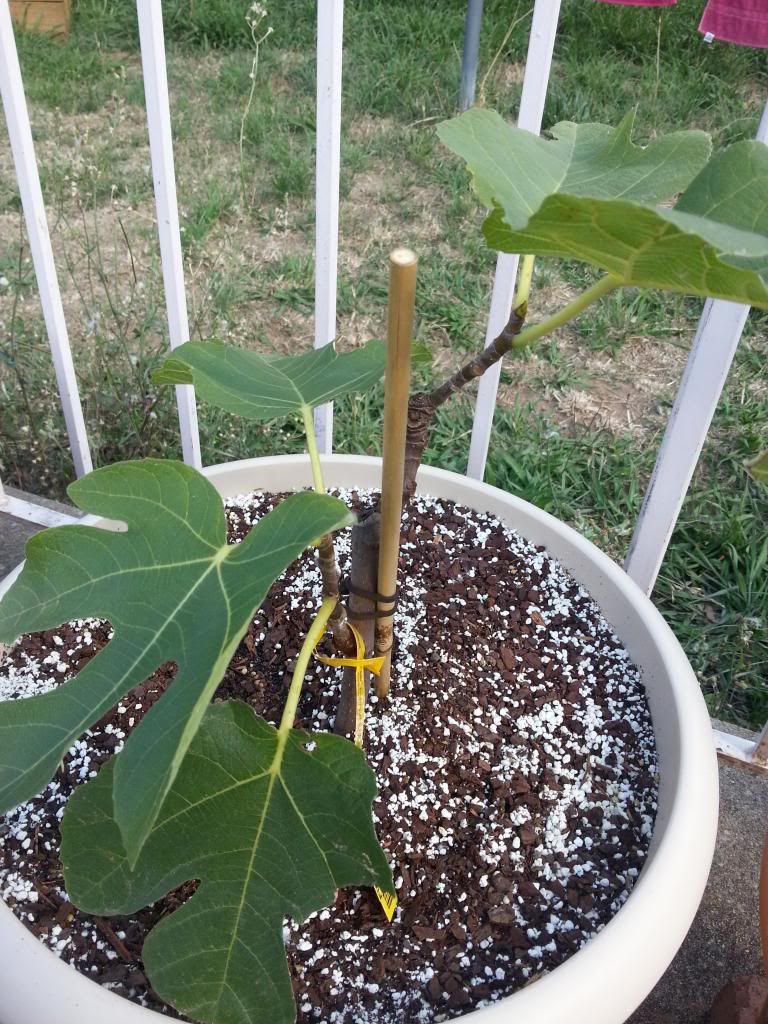
Showing posts with label fig. Show all posts

Monday, September 29, 2014

A Close Look at The Fig Collection - Black Genoa


Summary

Description: A very vigorous plant that tends to produce suckers from the base of the trunk. Extra-large, deep black fruit with excellent flavour. Grew poorly in 5-1-1 but loves coconut husk chip soil medium. Very intolerant to cold.

Breba Crop? No

Main crop taste? Delicious! Honey, sweet, figgy, really good.

Main crop appearance? Deep purple to black exterior, dark red interior.

Problems? Cold sensitive. Rust.

Overall plant rating 9.5/10

The Plant

I bought my Black Genoa from Daleys in January 2013, along with my White Adriatic and Brown Turkey.

On arrival the plant looked like it had seen better days.

Black Genoa, after re-potting into 5-1-1 a day after receiving from Daley's
I had explored the garden web forums for a suitable potting media, and had settled on 5-1-1. After a month however the plant looked worse than when I got it!

28 days later - 3rd March 2013
As I was having similar problems with my other trees, I transferred into a coconut husk mix at first opportunity, as soon as it went dormant, and it woke up in the spring of 2013 looking great.

9 October 2013
My Black Genoa breaks bud later than almost all my other figs, and is quite easily cold damaged. On October 19 we had a deep frost, and many leaves on my Black Genoa were killed. My other trees were fine.

Frost damaged leaves 19 October 2013
By December it was though nothing had happened, and Black Genoa was proving itself to be very vigorous, sending out several suckers from the base of the plant.

18 December 2013

The Fruit

My Black Genoa began to ripen its first fruit by the end of January. These fruit were deep black, and the largest of all my plants.

29 January 2014
I picked this first fruit a little too early in my eagerness. However the taste was still very good to excellent!

Could have used a few more days!
Very tasty!
Perhaps the best thing about the Black Genoa was the size of the later fruit. It produces, by far the largest of all my plants.

Ripe this time - Apple for scale! February 22 2014
Coin for scale
Juicy, delicious!
Black Genoa continued producing fruit into March

18 March 2014
More large fruit!
Sticky dark pulp.

Problems

Apart from its frost and cold sensitivity, Black Genoa was somewhat affected by rust toward the end of the season. Sadly I don't have a picture to show the extent, but will update this year! 

Friday, March 21, 2014

A Close Look at The Fig Collection - White Adriatic

I have been planning to update each of my figs for a long time now, especially as I am beginning to see fruit off of many of my trees. Today I will start with one of my favourites; White Adriatic.

Summary

Description; A vigorous plant that produced a number of breba and main crop figs. Performed poorly in 5-1-1 and enjoyed coconut husk chips in a larger pot.

Breba Crop? Yes

Breba taste? Sweet honey-nut

Breba appearance? Mottled, areas of deep red to light pink to pale pink

Main crop taste? Rich, sweet, berry

Main crop appearance? Uniform deep dark red

Problems? Rust

The Plant

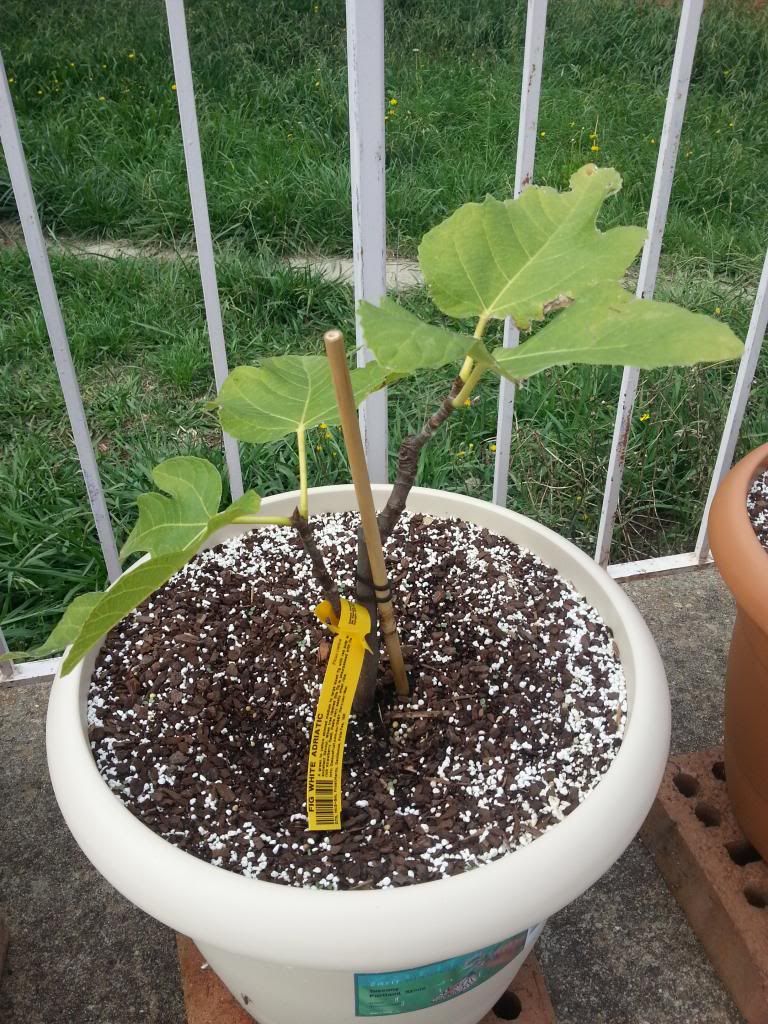
I purchased my White Adriatic from Daley's Online Nursery in January 2013, it came nicely boxed, and I can still remember that of the three fig trees I bought when I opened the White Adriatic box I was greeted with a wonderful figgy aroma of the leaves.

In March 2013, my plant looked like this, about a week after transplanting;

5th Feb 2013 White Adriatic
I originally potted my White Adriatic into 5-1-1 potting mix, and had great expectation for growth. Sadly, however, this was not to be, and 28 days later my plant had gone backwards slightly, losing some leaves and colour.

3rd March 2013 White Adriatic
By April that year it had begun to put out a small amount of new growth, but lost it all shortly thereafter with the first frost.

5th April 2013 White Adriatic
I suspected that the soil mix I had used was the cause of my lackluster growth, and took the opportunity to repot the plant into a larger pot, with a mix made primarily of coconut husk chips.

28 July 2013 White Adriatic in a new soil mix and larger pot
Shortly after repotting, the plant took off. Buds broke about 2 weeks later, one of the earliest figs in my collection to break.

15th September 2013 - White Adriatic bud break
After this, growth took off in my new container mix, and just 8 days later my White Adriatic already had more leaves than in the months preceding dormancy!

23rd September 2013 White Adriatic
Another two weeks, and growth was speeding along! In less than a month from breaking dormancy this plant had put off more growth in its new container mix than the 3 months prior to dormancy! I was amazed.

9th October 2013 White Adriatic
By December White Adriatic was producing its first figs.

12 December 2013 White Adriatic
Today, about a month before dormancy, my White Adriatic barely resembles the plant I purchased a year ago.

18 March 2014 White Adriatic 

The Fruit

My White Adriatic ripened its first two fruits at the end of January, these were breba figs.

31 January 2014 - First ripened fruit
The first fruits were small to medium in size, with a varied interior ranging from dark red to light pink.

1 February 2014 - White Adriatic breba crop fruit
 
1 February 2014 - White Adriatic breba crop interior
 The flavour was sweet, honey like and tasty. 

Later in the season my White Adriatic ripened some of its main crop, which had different colour and texture to the breba;

20th March 2014 - White Adriatic main crop
20th March 2014 - White Adriatic main crop interior
The main crop was much juicier than the breba with a uniform deep red colour. Its flavour was rich, sweet and berry-like. Far superior to the breba.

My White Adriatic still has a number of unripe fruit on its branches, however as the season draws to a close for the year I don't believe too many more will ripen, the plant is still young however,and I expect a much larger crop next year!

Problems

My White Adriatic has been moderately affected by rust in the last few weeks, likely a result of a larger amount of rain in the previous weeks. Rust begins as brown spots on the undersides of leaves, and can cause defoliation. Once rust appears it is difficult to deal with. Rust is fungus that spreads its spores from leaf to leaf through water droplets and can be treated in dormant phase with a copper based fungicide. All dropped leaves from rust infected plants should be destroyed.   

Rust on White Adriatic

Tuesday, September 10, 2013

Garden update: Spring Has Sprung, and the Fig Collection Updated

Plants waking up


Well it’s an exciting time of year right now, as the whole garden wakes up. Almost all my plants have broken dormancy and leafed out, except for a few who are hanging on for a little longer.

The black mulberry is showing the most growth, leafing out on almost every bud with leaves and berries, although the nectarine and peach are both furiously growing leaves too.
 
Leafing Out Nicely

Berries looking good!

The blueberries are all beginning to put out masses of flowers, and the rabbit eyes are putting on new growth as well, with the highbush types a couple of weeks behind. Interestingly this winter, all the highbush types defoliated with the cooler weather whilst the rabbiteyes held on to the majority of leaves. The little Sunshine Blue didn’t lose a single leaf and even started putting out flowers mid-winter, and is now absolutely covered in them. I haven’t seen any pollinators around just yet, so hopefully those flowers turn into berries and don’t just drop off!

Sunshine Blue Started Flowering Mid-Winter

Lots of New Growth on Misty
Flowers on Powder-Blue

New Flowers on Denise
It is my figs trees, however, that I am the most excited about. Many of my figs have had their buds begin to swell and a couple have begun leafing out, although no full leaves have yet emerged.

Since my last post on my fig collection I have added a bunch more varieties, bringing my total named count of fig varieties to 10.

These varieties are;
White Adriatic
White Niccolina
Black Genoa
Brown Turkey
Blue Provence
Yellow Excell
Pink Jerusalem
St Dominique’s Violette
Italian Honey
Preston’s Prolific

I will keep regular updates and photos of these plants throughout the year, to see the various traits and characteristics of each, and of course how tasty they turn out to be!

Out of all the figs, the white figs seem to be breaking dormancy the fastest, in particular the Excell, White Adriatic, Italian Honey and White Niccolina. The Black Genoa, and my little unnamed dark fig are not too far behind. It is probably no coincidence, but the figs that came to me topped (with their terminal buds removed) are the slowest of all my trees, and these plants are yet to show any signs of waking. My guess is that the smaller buds that grow along a stem take more time to develop to the stage where they can leaf out.
New Growth on White Adriatic
New Growth on Yellow Excell

I will be fertilising my figs today with a mixture from figtrees.net which calls for 1 part bonemeal (I’m using blood and bone), 1 part garden lime (I’m using dolomitic lime), and one part superphosphate. After mixing I will make a hole in 4-6 places at the edge of each pot, depending on the pot size, and give about a cup divided across the holes, per 30cm pot.

This recipe has been devised by a long time fig grower, who has a fair bit of experience growing figs in containers, and you can read his original instructions right at the bottom of his page here.

Wednesday, May 8, 2013

Garden Updates

First Real Frost!

Icy Silverbeet
On Monday I awoke to find the yard carpeted in a shimmer of white, as the first real frost of the season hit. Well, that is to say, the first frost I was up early enough to witness! It was cold enough that as I went to water the garden I spent 5 minutes trying to find the kink in the hose before realising that the hose had frozen solid somewhere.

It was also cold enough to partially defoliate my fig tree that is planted in the ground, although my figs in pots were spared, being up off the ground.

This fig tree hadn't lost any leaves until Monday

Tree Removal

Although currently hit by a nasty flu, I woke up Sunday feeling inspired enough to tackle the Privet trees in my backyard (which I previously had thought were camphor Laurels!). Privets (and Laurels) are a noxious weed in many parts of Australia due to their ability to spread extremely easily via birds, who eat the small berries they produce, and by their vigorous growth, which forms thickets and out-competes native and other plants for sunlight.

Privet Thicket

Privet Leaves and Berries

Each Privet berry contains two small seeds which germinate readily in exposed or disturbed soil. Privet can also regrow via suckers along their roots, so I hope I removed enough so that I don't have another wave of plants come up!

The thicket in my backyard was actually a clump of about 20 trees. A mature privet, according to an Australian Government website, has the ability to produce up to a million seeds per year, and the berries support unnaturally high populations of Currawongs which then displace other native birds. 

The invasiveness of the tree can easily be seen after I chopped off their heads, and it became evident how many trees were growing in the thicket. I have since dug them all up, and planted a brand new persimmon tree in their place.

In Canberra the ACT Government sponsors a weed exchange, where you bring in certain varieties of woody invasive weeds, and they exchange them for a native plant. Privet meets these requirements, although I think I have missed the swap, which usually occurs twice a year in early Autumn and Spring. HERE is a link for those in the ACT with privet trees in their backyard, and who would like some extra encouragement to chop them down!

There Were 21 Individual Trees Here!

Cauliflower Harvest

On Sunday I harvested my first cauliflower. It was a nice size and weighed in at just over 800g. If growing without insecticides, as I am, it is a good idea to soak your newly picked cauliflower in salt and water, as it will drive out any caterpillars that may have taken up residence!

Cauliflower With Beer for Reference

I immediately cooked it up into a delicious Indian curry, which is very tasty and great for those who like curry, but are scared of spicy food. It is very easy to make, and I encourage everyone to try it!

Mild Cauliflower Curry in a Coconut Sauce

Ingredients:
2 tbs oil
1 cauliflower
1 onion
2 tomatoes
2 tsp garlic
1 tsp salt
1 tsp sugar
2 tsp cumin seeds
1-3 chillies (optional)
1 teaspoon tumeric powder
1.5 teaspoon tamarind paste
3/4 cup of warm water 
400ml coconut milk

Method

1. Cut the cauliflower into small florets, rinse, and set aside. Dice the tomato into medium to small chunks and set aside. Add 1.5 tsp tamarind paste to the warm water, mix well and set aside. 


2. Chop the onion and chillies (if using) and put in a food processor with the garlic and tumeric and blend to a paste.


3. Heat the oil in a wok or pot and add the cumin seeds until they start to splutter. Add the spice mix from the processor and cook on medium for 5 minutes, making sure it doesn't burn.


4. Add the cauliflower florets, and stir to coat with the spice mixture in the pan, and cook for a further 5-10 minutes stirring constantly.


5. Stir in the coconut milk, salt and sugar and cook for 10 minutes before adding the tamarind water mixture. Do not let it boil or the coconut milk might separate. If the mixture is too watery, simmer gently until it reaches your preferred consistency. Finally add the chopped tomato, allow to heat through for 5 more minutes before serving!
  

Thursday, March 21, 2013

The Fig Collection


I have always been a great fan of figs. Recently when overseas in France I would visit the market twice a week and proceed to eat two whole punnets of figs, in a single day.

It was great.

Once picked, figs do not ripen any more, and spoil very quickly. Figs when fully ripe are very soft and difficult to transport in-tact and this means that, sadly, figs are often picked a little too early for market, before they reach the maximum sweetness, and depth of flavour you can get leaving it on the tree until fully ripe.

I find fig trees themselves quite an attractive plant, with large lobed leaves, often with varied shapes. When disturbed or crushed, fig leaves also give off a beautiful aroma, sweet and figgy.

I grow the majority of my figs in a soil-less mix, and as of yet they are all quite young and unimpressive, but as they grow quite quickly they should begin to look more respectable as Spring rolls round again.


Brown Turkey

The Brown Turkey is common variety fig, not only in Australia but throughout the world. In most nurseries you come across in Australia this will be the variety stocked. Brown Turkey figs are hardy trees and form small to medium size figs that are rich and sweet. Brown Turkey figs produce a breba crop on last seasons wood in summer, and a main crop in Autumn on new growth.

My Brown Turkey has had very slow growth since re-potting in January. In the last two weeks it has begun to wake up a little, and I think I may have been under-watering.


White Adriatic

White Adriatic is a fig originally coming from the Mediterranean. White Adriatic figs form one or two crops and have pale green-yellow skin turning pale to almost white as they mature.

White Adriatic figs are meant to be particularly sweet and rich, good for jams and drying.

Like the Brown Turkey, my White Adriatic has had fairly slow growth, probably due to under-watering. In the last two weeks with extra water it has began to put out its first growth since I purchased it in January.


Black Genoa

The Black Genoa is a variety that is uncommon outside of Australia. It is a quick growing tree with medium sized sweet fruit. It is the second most common variety you will see in the average Australian nursery. It is often used as a commercial fruit here as it is prolific and easy growing with relatively hardy fruit.

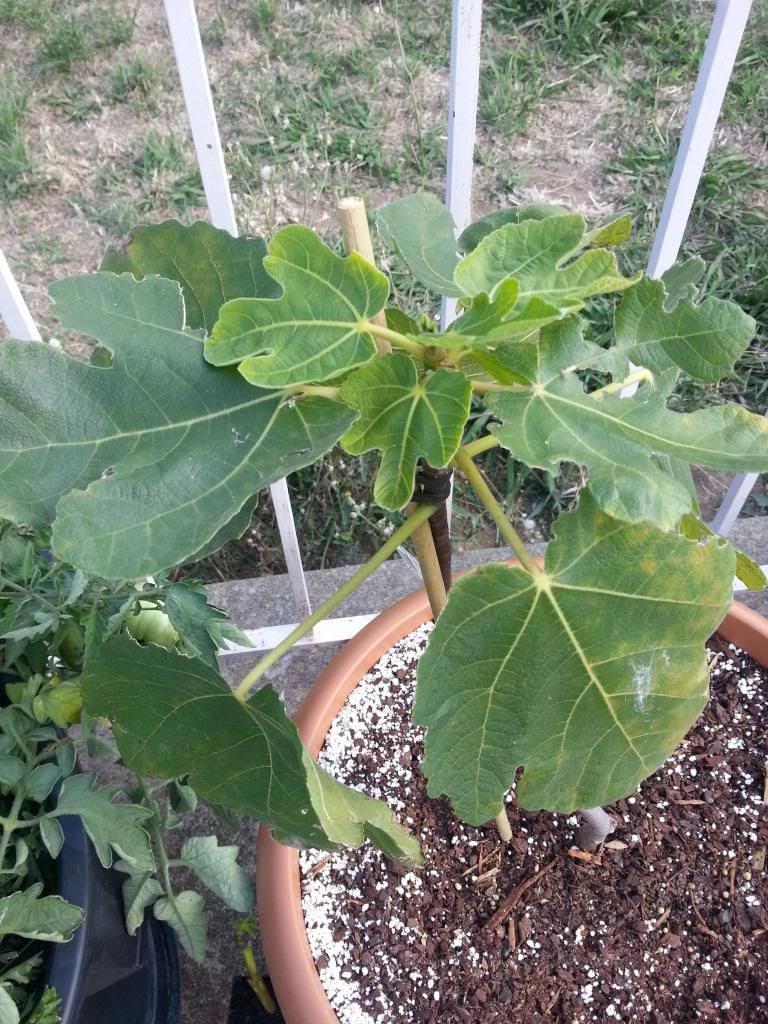
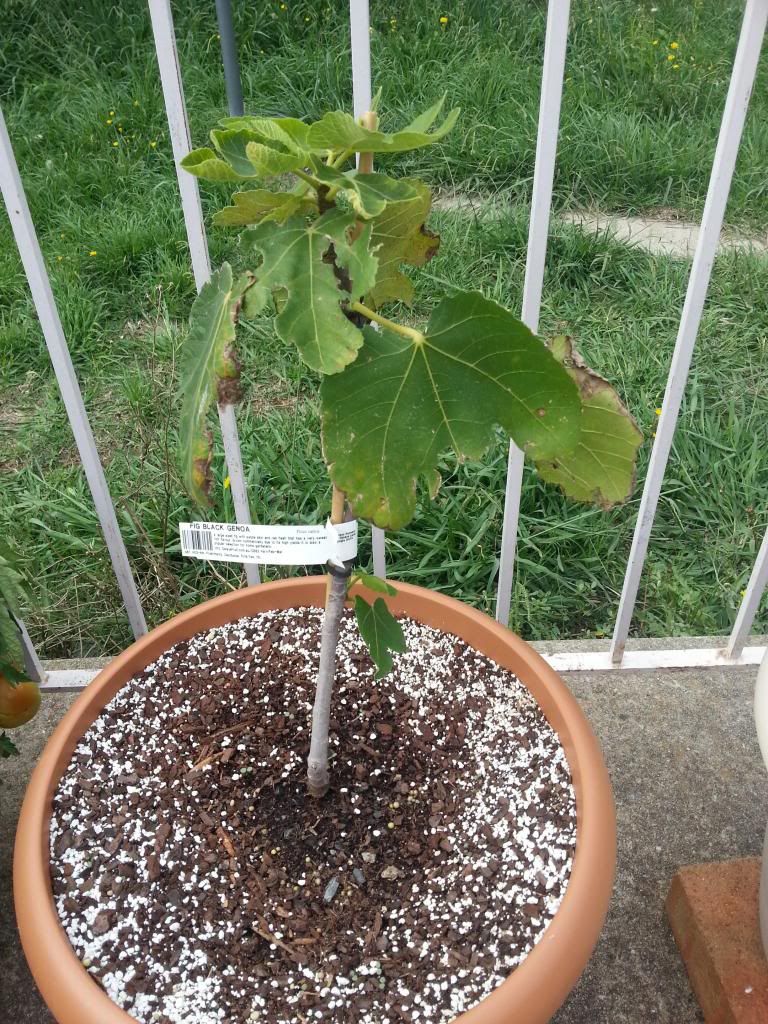
My Black Genoa is the fastest growing of my container figs, putting out some sucker growth and several leaves. 


Yellow Excell

The Yellow Excell is the newest of my plants, and I stumbled upon it at Bunnings one afternoon. I have not previously seen this variety in nurseries. Excell figs ripen to a yellow colour, and are reportedly extremely sweet, rich and excellent for drying and making jams. I am looking forward to tasting this fig, probably next year.

This plant was hidden right up the back of the fruit trees at Bunnings, and was in fairly bad shape when I picked it up. Since purchasing from Bunnings two weeks ago, it has dropped a few leaves since being re-potted, and in the last week some of the buds have begun to swell, so I am hoping it will put out a little bit of growth before winter dormancy.


Mystery Figs

In previous posts you have met my latest fig cuttings, taken from a tree between Canberra and Orange, and today they sit, still looking fairly lifeless, with only a hint of a green flush in the buds waiting to put forward some leaves.

Back in December I took another random cutting from a large tree overhanging a fence in my suburb. It kind of sat there looking quite sad and unhappy with life all through January, and then in February it began to put out some leaves. Today I have great expectations for this plant, especially after re-visiting the donor fig and finding it covered in small dark figs, with a deep red interior.


Picture on the left taken at the end of Feb


Picture on the right taken mid-March

Latest Posts