Showing posts with label blueberries. Show all posts

Monday, November 4, 2013

One Important Change You Can Make For Healthy Blueberry Plants

How to Fix Yellowing Blueberry Leaves

Healthy Blueberry

I learnt a valuable lesson this year, when despite having blueberries in a low pH soil medium, they refused to grow and were suffering. Wondering why, I delved into the internet, and can now offer this very important, and simple tip.

Previously I wrote about the very specific soil needs of blueberries, and said that for blueberries to grow healthily they need a low soil pH, or they will slowly deteriorate and eventually die, however there is another consideration to make, but first how do we identify pH problems in blueberries.

Blueberry Deficiencies Caused by High pH

Blueberries affected by high pH die from a lack of some nutrients and an overdose of others. In particular blueberries lack iron and have trouble regulating the absorption of calcium in high pH environments.

Initially these deficiencies will be marked by yellowing between the veins of the leaves of your plants, and as the situation worsens will spread to the leaf tips, and eventually whole leaves yellowing and dropping, this is known as iron chloriosis. Plants in this state will become stunted, slowly languishing before they eventually die.

Chloriosis Due to Iron Deficiency from High pH
Without Intervention This Plant Will Eventually Die 

So How Do We Prevent This?

Initially, planting in an acidic media like pine bark, peat moss or azalea potting mix will provide an acidic environment however, over time, this may not be enough. This is because in many places the water that comes from your tap has quite a high pH. Over time, carbonates and bicarbonates accumulate in the soil media, raising the pH and making the environment unsuitable for growing blueberries.

In Canberra, at my house, tap water has quite a high pH of at least 7.5 .

Canberra Tap Water pH is Much Too High For Healthy Blueberries
There are a couple of answers to the problem.

Irriagte With Rainwater

The first and most simple solution is to irrigate with rain water or distilled water. Rain water actually has a pH often around 6-7, however it is totally free of bicarbonates, which are actually the culprit. If you water solely with rain water or distilled water, you will have no problems with your blueberries, provided your soil media itself is still acidic. Tap water is often full of compounds such as calcium bicarbonate which increase the hardness or alkalinity of the water.

Acidify Your Water

If you have been watering with tap water for a while now, and have accumulated bicarbonates and carbonates in your potting mix, and are suffering nutrient deficiencies, rainwater will not be enough and you may need a more forceful approach. This is done by acidifying the water in your watering can before watering your plants.

As you add acidified water, bicarbonates are neutralised, and the pH and alkalinity of your potting media will drop.

Be careful not to overdo it though, too much acid will most definitely kill your plants! It is a good idea to purchase a water pH testing kit, and add enough acid to lower the water pH to about pH 5.

Which Acid to Use?

Adding acid can sound pretty daunting until we think of all the acids around us. Vinegar also known as acetic or ethanoic acid, is a common acid found in almost every single house, as is the citric acids found in citrus fruit or even the tartaric acid found in many fruits and in pantries labelled as cream of tartar. Not all of these are suitable however for adding to your irrigation water.

Acidifying Water with Vinegar

For the simplest, cheapest and safest solution vinegar is the way to go. It is not an ideal acid to use, but should suffice if you add it to your water consistently. Vinegar is inferior to other acids because it is a weak, organic acid, and which will be broken down by bacteria in the soil, so that over time the bicarbonates that have neutralised, held by the acid, will be released back into the soil.

A much more effective solution is an in-organic acid such as sulphuric acid. But first a word about safety.

Safety and handling with Sulphuric Acid



I debated with myself whether or not I should write about using sulphuric acid to acidify water for blueberries, because it can be extremely dangerous. I then thought of the difficulty I had finding quality information myself, as well as a detailed description of the risks involved. Finally I decided that people will do dangerous things regardless, and I would rather you had full (or at least expanded) understanding of the risks and how to mitigate them as much as possible.

So, first of all a disclaimer: Use sulphuric acid at your own risk. Although very dilute sulphuric acid is relatively safe to handle, if done carefully, I do not recommend handling or storing strong acids such as sulphuric acid in solutions above 10% concentration. The information below is for your information purposes only, and to make you aware of the dangers associated with handling and storing concentrated strong acids. If you can only buy strong acids above 10% in concentration, ask the store professional to dilute it for you, if at all possible.

Acids can be dangerous. Acids can be VERY dangerous in higher concentrations and sulphuric acid is one of these.

When diluted below 10% sulphuric acid is relatively safe. Even diluted however it will corrode fabric, damage metals, some plastics and other materials and cause irritation or burns to your skin. If washed off immediately with cool running water, there will likely be little to no negative effect. If you spill or splash diluted (less than 10%) concentrated sulphuric acid, wash under cool running water for at least 30 minutes. You probably will not need medical attention. Discard any clothing that has been splashed with acid.

More dangerous concentrations of sulphuric acid are those above 10%. The concentration of the acid will be written on the bottle.

The Bottle I Received - Acid at This Strength Is Probably Not Worth The Risk
Concentrated sulphuric acid is another beast altogether. In high concentrations it will eat through or destroy most materials including metal, can etch concrete and can only be stored in certain types of plastic or glass vessels. More importantly as concentration increases it will quite literally EAT YOUR SKIN TO THE BONE. This will be horrifically painful, and will scar. To make matters worse adding water to highly concentrated sulphuric causes the release of a large amount of heat, and will cause high level burns.

Mist or vapour from highly concentrated sulphuric is also extremely dangerous.

Do NOT play around or underestimate the danger of highly concentrated sulphuric acid.

In Australia you can find sulphuric acid in dangerously high concentrations. The sulphuric acid I bought for my blueberries came to me at 98% concentration. AKA eat the skin off your bones concentration. Avoid this risk at all costs and instead try and find sulphuric sold as battery acid, generally at 30-35% concentrations. You should be able to find this at car stores and some mechanics.

At this 35% concentration, sulphuric will eat through your clothes and damage metals. It will cause painful burns on your skin if you spill it, and will cause great damage your eyes and mouth if it splashes. The mist and fumes will damage your throat, nose and lungs if breathed. However, provided you are careful and treat the acid with respect I believe most adults can safely dilute battery acid concentrations of sulphuric themselves by adding it to water.


You need to add 1L of 35% sulphuric acid to at least 3.5L of water to bring your sulfuric below 10% concentration, which is quite safe for use and storage. NEVER add the acid first, always put the water in your container first, and then add the acid SLOWLY and CAREFULLY second. Pour the liquid at arms-length with your face turned to avoid any possible splashes. Do not mix in an enclosed space, as the fumes are toxic. Break between pouring so that the liquid has a chance to diffuse the heat that will be produced.

Always Add Acid to Water – Not Water to Acid


When sulphuric acid comes in contact with water a large amount of heat is released, and adding water to acid can cause the liquid to instantly boil and spray you with acid. Add the water FIRST, acid SECOND. Wear safety glasses, a long sleeved shirt and pants, gloves and covered shoes. If you get any acid on your skin or clothes, remove your clothing and rinse the area thoroughly with cool running water for at least 30 minutes. Seek medical advice as soon as possible.

If you can only find acid in higher concentrations than battery acid at 35% then you need additional safety precautions. At 98% concentration, you will need a minimum of 16.2 litres of water to bring your acid into safer concentrations. You will need a protective face covering/mask, and on top of long pants and shirt, a coverall that will protect from any splashes. Even a drop of acid at this concentration will cause instant burns and will scar. If you spill any, wash immediately with copious amounts of water for at least 30 minutes. It will burn. Seek immediate medical attention.

Sorry to harp on about this, many times in our day we are warned about potential dangers and how bad something can possibly be, only to find out the risk was greatly exaggerated. This is not one of these times. Concentrated sulphuric acid can, and will, irrevocably change your life if you have a bad accident.

Here is a rough guide as to the amount of water needed to dilute 1L of different concentrations of sulphuric acid to safe levels (<10%);

10% and below = safe;
1L sulphuric at;
15% concentration = add to 600ml water
20% = add to 1.2L water
30% = add to 2.5L water
40% = add to 4L water
50% = add to 5.6L water
60% = add to 7.5L water
70% = add to 9.6L water
80% = add to 12.1L of water
90% = add to 14.6L of water
98% = add to 16.2L of water

Dilute sulphuric acid can be safely stored in most plastic containers, but to be sure most containers have the plastic type on the bottom. On the chart below, the top row is are different types of plastic, and the far left column is the type of liquid being stored.

Green Can be Stored Safely for More Than 30 Days, Blue Up to 30 Days

Are You Serious, Why Would I Even Consider Something So Potentially Dangerous?

Sulphuric acid is a non-organic acid. Once it is added to your container it will permanently bind the carbonates and bicarbonates in your water and soil media, rendering them as neutral compounds that will not hurt your blueberries.  Once you have dilute sulphuric acid, a small amount will last a long time.

If you can find sulphuric acid already diluted to below 10% the risk is very minimal, and is no more dangerous than handling pesticides, poisons, petrol or other dangerous substances you may find in your garden shed. In fact, I regularly used dilute sulfuric and hydrochloric acid in highschool.

How much Dilute Acid to Add to Your Watering-can?

Now that the safety information is out of the way, how much dilute sulphuric should you add? Very little. A teaspoon of 10% sulphuric acid is far too much to add to a standard 9L watering can, and it is worthwhile diluting your acid down in half again, and putting it in a container for daily use.

A Pipette Can be Used to Extract Small Amounts of Liquid Safely 
It is also worthwhile purchasing some plastic pipettes from ebay, which will cost you a couple of dollars, and will allow you to measure out small amounts of acid to transfer to your watering can. I add approximately 2ml of very dilute acid to 9L for my plants. I determined this amount using a water pH testing kit, and added small amounts of acid to my watering can until I reached a pH of 5. This may vary for you.

This is Almost Too Acidic, and Could Be Diluted With Even More Water
After all your initial hard work getting dilute sulphuric acid, when you need only 1ml at a time 1 litre of dilute acid will last a long, long time.

Whichever method you choose; watering with distilled or rain water, using vinegar or using sulphuric acid, hopefully any problems with chloriotic blueberry plants will be reversed shortly!

Healthy Green Leaves Again

Thursday, October 31, 2013

Berries in Spring in Canberra

Besides figs, berries are some of my favourite things to eat. Always full of flavour, most berries are also extremely high in antioxidants and other healthy goodness. Blueberries in particular are always being touted as superfoods.

Blueberries 


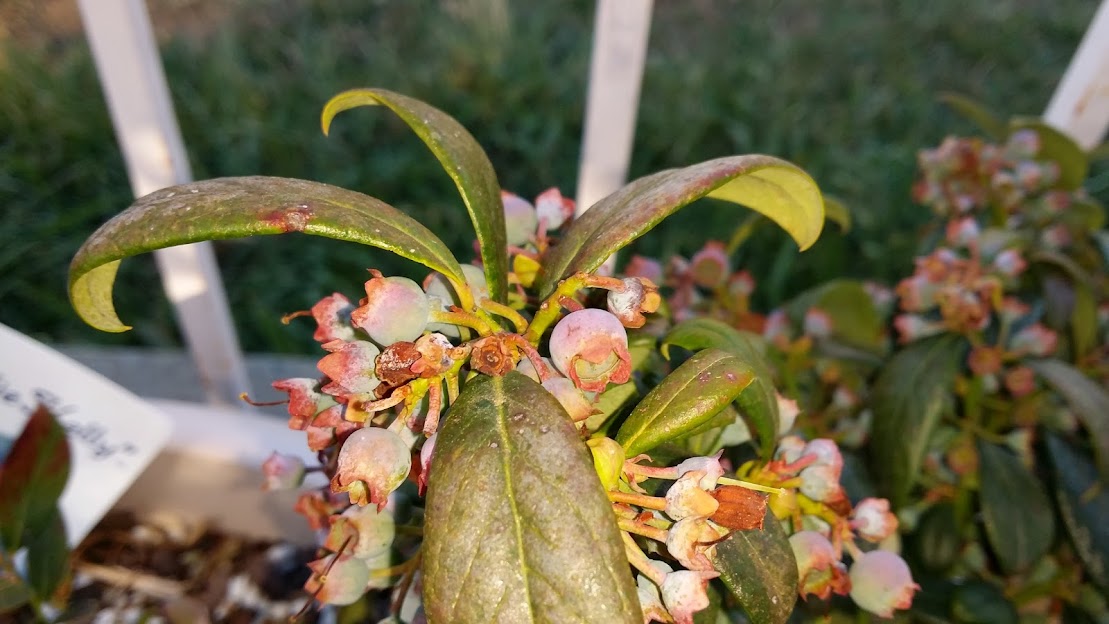
Unripe Berried on Powder-Blue

All my blueberries are coming along nicely, except for one, which flowered profusely and then unexpectedly died with the big frost two weeks ago. 

Although I haven't seen any bees around to pollinate, it appears that almost every flower on each blueberry plant was pollinated, and now there are a good number of berries coming along on all my different plants.
Legacy
Brightwell
Sunshine Blue
Brigitta

Chillean Guava


The Chillean Guava are beginning to put out flower buds, which I expect to open in the next few weeks. The smaller plants seem to be too young to put many flower buds out, however the larger plants I bought from a local nursery appear to have a good number. I am very excited to try the berries later in the year!

Chillean Guava Putting out Flower Buds

Black Mulberry


Mulberries Soon!
The Black Mulberry tree was hit fairly hard with the heavy frost about a week or so ago, and lost a number of leaves, buds and dropped some berries. There is still quite a good number of berries on it however, and some of them are beginning to turn red. Hopefully I will have some tasty ripe mulberries in a couple of weeks.

Lost Many Berries to Frost But Plenty Remain!

Strawberries and Raspberries

Strawberry Flowers
Strawberries and raspberries are going mad. They love the sunshine, and are both taking over the space they have been given. In particular raspberries are quite aggressive and send suckered shoots quite far from the parent plant. If you are considering planting raspberries in your garden, be sure to contain them well.

Strawberries Taking Over
Autumn Baring Raspberries

Tuesday, September 10, 2013

Garden update: Spring Has Sprung, and the Fig Collection Updated

Plants waking up


Well it’s an exciting time of year right now, as the whole garden wakes up. Almost all my plants have broken dormancy and leafed out, except for a few who are hanging on for a little longer.

The black mulberry is showing the most growth, leafing out on almost every bud with leaves and berries, although the nectarine and peach are both furiously growing leaves too.
 
Leafing Out Nicely

Berries looking good!

The blueberries are all beginning to put out masses of flowers, and the rabbit eyes are putting on new growth as well, with the highbush types a couple of weeks behind. Interestingly this winter, all the highbush types defoliated with the cooler weather whilst the rabbiteyes held on to the majority of leaves. The little Sunshine Blue didn’t lose a single leaf and even started putting out flowers mid-winter, and is now absolutely covered in them. I haven’t seen any pollinators around just yet, so hopefully those flowers turn into berries and don’t just drop off!

Sunshine Blue Started Flowering Mid-Winter

Lots of New Growth on Misty
Flowers on Powder-Blue

New Flowers on Denise
It is my figs trees, however, that I am the most excited about. Many of my figs have had their buds begin to swell and a couple have begun leafing out, although no full leaves have yet emerged.

Since my last post on my fig collection I have added a bunch more varieties, bringing my total named count of fig varieties to 10.

These varieties are;
White Adriatic
White Niccolina
Black Genoa
Brown Turkey
Blue Provence
Yellow Excell
Pink Jerusalem
St Dominique’s Violette
Italian Honey
Preston’s Prolific

I will keep regular updates and photos of these plants throughout the year, to see the various traits and characteristics of each, and of course how tasty they turn out to be!

Out of all the figs, the white figs seem to be breaking dormancy the fastest, in particular the Excell, White Adriatic, Italian Honey and White Niccolina. The Black Genoa, and my little unnamed dark fig are not too far behind. It is probably no coincidence, but the figs that came to me topped (with their terminal buds removed) are the slowest of all my trees, and these plants are yet to show any signs of waking. My guess is that the smaller buds that grow along a stem take more time to develop to the stage where they can leaf out.
New Growth on White Adriatic
New Growth on Yellow Excell

I will be fertilising my figs today with a mixture from figtrees.net which calls for 1 part bonemeal (I’m using blood and bone), 1 part garden lime (I’m using dolomitic lime), and one part superphosphate. After mixing I will make a hole in 4-6 places at the edge of each pot, depending on the pot size, and give about a cup divided across the holes, per 30cm pot.

This recipe has been devised by a long time fig grower, who has a fair bit of experience growing figs in containers, and you can read his original instructions right at the bottom of his page here.

Monday, March 25, 2013

Growing Blueberries!


Along with figs, this year I am trying my hand at blueberries. I currently have seven varieties, six in containers.

Blueberries 

Blueberries can be a little trickier than some fruits to grow. They have specific soil and nutrition needs and for decent crops need to be cross pollinated. Blueberries are often advertised as self-fertile, however cross pollination with another blueberry of the same type will greatly increase both yield and berry size. Blueberries also require a number of chill hours in order to set fruit.

However it is important that you choose blueberry plants from the same type, as not all blueberry plants will cross-pollinate with each other.

Soil selection

Blueberries are quite particular in their soil needs. They enjoy an acidic soil with a pH between 4.5-6.

Blueberries over time have adapted to lower pH environments, which today means that they will suffer mineral deficiencies in higher pH soils. In particular blueberries will suffer from an iron deficiency as their ability to absorb iron decreases with higher pH. Iron deficiency in blueberries is marked by chloriotic (yellowing), leaves.

Blueberries also require a free draining soil, free from weed competition. Blueberry root systems are very shallow.

Nutritional Needs

Blueberries have a different root system to the majority of plants. Normally, plants will form roots, and then fine feeder hairs, to collect nutrients. Blueberries lack these fine hair-like roots, and instead, form a symbiotic relationship with mycorrhizal fungi.

Blueberries are somewhat different from other plants in their nitrogen needs. Nitrogen (N) is an essential element that promotes leafy growth in plants, and in most fertilisers exists in a nitrate form. In chemistry nitrates have a chemical composition of NO3. Blueberries, and some other acid loving plants, prefer to receive nitrogen in an ammonia form, which has a chemical composition of NH4. Because of this, it is important when choosing a fertiliser for blueberries that you select one with an ammonia based nitrogen source. Generally, this can be found in acid-loving fertiliser mixes.

Below is a picture on the difference in blueberry root development when fed with a nitrate (NO3) vs ammonia (NH4) based fertiliser. The source of this picture, and lots of additional fertilising information can be found in this paper.


Blueberry Types

Blueberries come in three common types, blueberries will cross-pollinate with other plants within the same type, although some studies have shown limited cross pollination with blueberries of another type, in particular Southern Highbush and Rabbiteye types. To be safe, plant at least two varieties of the same type together.

Highbush

Highbush blueberries are so named because of their taller stature, sometimes growing up to 3m tall. Highbush types have a high chilling hour requirement, needing at least 1000 hours under 2oC to satisfy their dormancy requirements. These plants are quite hardy and frost tolerant. Highbush types are also able to tolerate high summer temperatures, making them great for cooler Australian climates.

This year, I have planted two varieties of Highbush blueberries

Blue Rose


Denise


Edit, on 30 March I added two new Highbush blueberries to the collection; Brigitta an Blue Crop


Southern Highbush

Southern Highbush types have lower chill hour requirements than Highbush types, needing between 250-600 hours of chill. Southern Highbush types do not have the frost tolerance of Highbush types and must be protected in areas like Canberra. Southern Highbush types have a tolerance for heat.

In Australia Southern Highbush varieties account for up to 80% of total blueberry production, due to the extended growing season.

Growing Southern Highbush types in Canberra can be troublesome due to our cold winters. Blueberries are perennials, meaning they live for many years, and in cold areas will die back each spring as cold weather approaches, to re-grow in Spring. Blueberries in containers should be moved to a warmer location to over-winter, and Southern Blueberries in the ground need extra frost protection if they are to survive.

This year, I have three Southern Highbush varieties

Legacy


Sunshine Blue


Misty


Rabbiteye

Rabbiteye blueberries are so-called due to their appearance when ripening looking (unsurprisingly) like the eye of a rabbit when the berries are in their pink stage. Rabbiteye varieties often have larger fruits, with thinner skins. Rabbiteye varieties can grow as large as, or even larger than Highbush types. Rabbiteye varieties have the ability to far out-live other types, growing for as long as 20 years or more.

Rabbiteye blueberries are low-chill varieties and need between 450-600 chill hours. Rabbiteye blueberries flower before Highbush types, and the flowers are very susceptible to spring frosts, and containerised plants should be moved to warmer locations if frost is predicted in spring. In Canberra, as the saying goes, you aren't (relatively) safe from frosts until Melbourne cup day, although late frosts into November or even December can occur.

This year, I have two Rabbiteye varieties;

Powderblue


Brightwell


Latest Posts